The Journal
How to Support Your Progesterone Levels Naturally
June 17, 2025
The hormone progesterone is only created once ovulation has occurred and has an anti-inflammatory effect during the luteal phase of a menstrual cycle - the period in time from ovulation to the day before your period. It is produced by the corpus luteum in the ovaries, and is an essential hormone for healthy periods, moods, restful sleep, clear skin, healthy breasts, and optimal immune function.
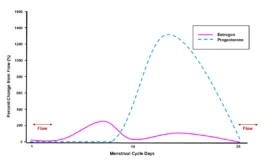
The fluctuations of oestrogen and progesterone in an ovulatory cycle
Additionally, adequate progesterone is needed to help prepare the endometrium for implantation of an embryo. It is therefore a crucial hormone for a successful pregnancy, as well as women's health overall.
If progesterone levels do not peak during the luteal phase of the cycle, this indicates an anovulatory cycle – meaning that ovulation did not occur. If progesterone levels rise in the luteal phase but only slightly, you are likely not making enough progesterone, and may therefore experience symptoms of low progesterone.
These can include:
- Mood changes
- Low mood
- Anxiety
- Irritability
- Poor sleep
- Decreased libido
- Bloating
- Fluid retention
Additionally, signs of low progesterone can include a short luteal phase (less than 10 days), low temperatures, and no or minimal fertile cervical mucus. An important note - if you experience a temperature shift in your cycle, but no period, I suggest taking a pregnancy test!
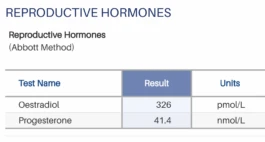
A progesterone level of 41.4nmol/L taken 7 days post-ovulation
If you have low progesterone levels, the ratio of progesterone to oestrogen will be imbalanced, which unfortunately can lead to both low progesterone and oestrogen excess symptoms. This is what people are generally referring to when they use the phrase ‘hormonal imbalance’. This term is not a diagnosis per se, but is used to describe when hormones are not sitting at the right levels, or the right ratios to each other, and therefore tend to produce adverse symptoms in our bodies.
If you identify with the signs of low progesterone, it is worth investigating your levels via a blood test.
When to test progesterone for your cycle:
I recommend testing serum progesterone 7 days post-ovulation which is the most accurate time to test. If you are unsure when you ovulate, you can also aim to test 7 days before your period.
Classically, progesterone testing is recommend on day 21 of your cycle, however this is only relevant if you ovulate on day 14, and have a 28 day cycle. If you know when you ovulate, count 7 days after ovulation and test on this day. If you’re not too sure or have varied lengths of your cycle, subtract 7 days from the length of your last few cycles and test on this day.
- For a 35 day cycle, test progesterone on day 28 (35 - 7 = 28)
- For a 21 day cycle, test on day 14
- For irregular cycles, I suggest basing the day of testing on your previous 3 cycles,
estimating when 7 days before your period may be. Your practitioner will be able
to interpret your progesterone results accordingly
You are aiming for a minimum of 35nmol/L of progesterone during your luteal phase peak for optimal health. Generally speaking higher is better, and although too much of any hormone is not a good thing, I have personally never seen a woman with progesterone levels that are ‘too high’!
If you are thinking about trying for a baby and find you have luteal phase progesterone levels that are less than 35, I suggest dedicating some time to increasing these before you try to conceive. Low progesterone levels may be predicative of first trimester miscarriage, so preconception care focused on supporting your progesterone levels is very important.
Progesterone levels are affected by energy availability, stress levels and specific nutrient intake. Additionally, some health conditions can impact the ability to ovulate - PCOS, gut problems, thyroid conditions, prolactinoma, and metabolic issues such as insulin resistance.
If you have low progesterone levels as found by testing on the correct day in the luteal phase of your cycle, here are some lifestyle, nutrient and herbal medicine treatment options for you.
- Ensure you are nourishing yourself
You need optimal levels of food to signal to your body that it is safe to bring a child into the world (aka ovulate)! Specifically, you need plenty of carbohydrates, fat, and calories! If you have missing or irregular periods from hypothalamic amenorrhea (HA) - which is a state of low progesterone - you likely need to aim for a minimum of 200 grams of carbohydrates daily, and upwards of 2,500 calories daily. - Take the progesterone stimulating herb Vitex
Vitex not only modulates progesterone, but it may also indirectly lead to an elevation in mood as progesterone is our natural ‘anti-depressant’ hormone. This herb also works well for PMS, hormonal acne, and period pain. If you have low progesterone due to PCOS, Vitex may not be a good option for you to take. Read more about why here. - Consider herbal hormonal modulators
These include Peony, Wild yam, Black cohosh, Shatavari, and Tribulus terrestris. Each herb has specific mechanism of action relating to the our hormones, including FSH, LH, oestrogen, progesterone, testosterone, and DHEAS. These are best taken under the guidance of an experienced practitioner. - Zinc
Increase your consumption of zinc as it is critical for hormone production! The top food sources are oysters, seafood, red meat, liver, eggs, and pumpkin seeds. When supplementing, I suggest 30 - 50mg after food. - B6
An essential water-soluble vitamin to support healthy ovulation. Top food sources of B6 include chicken, turkey, kangaroo, salmon, chickpeas, potatoes, banana, peanuts, pistachios, and sunflower seeds. If supplementing, a safe therapeutic dose ranges from 50 - 100mg daily. - Iodine
Essential for healthy cycles as it can down regulate oestrogen receptors - key if low progesterone is accompanied by oestrogen excess. If you experience breast tenderness/pain after ovulation that disappears when your period arrives, low iodine is likely the cause. You can test your iodine levels via a urinary test, which is most accurately completed first void of the morning, fasted. - Test prolactin levels
Prolactin and progesterone have an antagonist relationship and therefore elevated prolactin will suppress ovulation. To ensure prolactin levels are not hindering ovulation, test on day 2 of your cycle. - Stress reduction
A key part of treatment – this must be addressed and prioritised daily. This is very often one of the root causes of progesterone insufficiency. All of the beautiful nutrients and herbs in the world will not correct a progesterone deficiency caused by chronic stress. See this blog on how to support your stress levels.
Feel free to ask me your progesterone-related questions below, or reach out if you are looking for one-on-one support with your hormone health.
Author
Jaclyn Cave
BHSc (Nat), BComm (Soc)
Masters Womens Health Med (UNSW)
The Journal
How to Support Your Progesterone Levels Naturally
June 17, 2025
The hormone progesterone is only created once ovulation has occurred and has an anti-inflammatory effect during the luteal phase of a menstrual cycle - the period in time from ovulation to the day before your period. It is produced by the corpus luteum in the ovaries, and is an essential hormone for healthy periods, moods, restful sleep, clear skin, healthy breasts, and optimal immune function.
The fluctuations of oestrogen and progesterone in an ovulatory cycle
Additionally, adequate progesterone is needed to help prepare the endometrium for implantation of an embryo. It is therefore a crucial hormone for a successful pregnancy, as well as women's health overall.
If progesterone levels do not peak during the luteal phase of the cycle, this indicates an anovulatory cycle – meaning that ovulation did not occur. If progesterone levels rise in the luteal phase but only slightly, you are likely not making enough progesterone, and may therefore experience symptoms of low progesterone.
These can include:
- Mood changes
- Low mood
- Anxiety
- Irritability
- Poor sleep
- Decreased libido
- Bloating
- Fluid retention
Additionally, signs of low progesterone can include a short luteal phase (less than 10 days), low temperatures, and no or minimal fertile cervical mucus. An important note - if you experience a temperature shift in your cycle, but no period, I suggest taking a pregnancy test!
A progesterone level of 41.4nmol/L taken 7 days post-ovulation
If you have low progesterone levels, the ratio of progesterone to oestrogen will be imbalanced, which unfortunately can lead to both low progesterone and oestrogen excess symptoms. This is what people are generally referring to when they use the phrase ‘hormonal imbalance’. This term is not a diagnosis per se, but is used to describe when hormones are not sitting at the right levels, or the right ratios to each other, and therefore tend to produce adverse symptoms in our bodies.
If you identify with the signs of low progesterone, it is worth investigating your levels via a blood test.
When to test progesterone for your cycle:
I recommend testing serum progesterone 7 days post-ovulation which is the most accurate time to test. If you are unsure when you ovulate, you can also aim to test 7 days before your period.
Classically, progesterone testing is recommend on day 21 of your cycle, however this is only relevant if you ovulate on day 14, and have a 28 day cycle. If you know when you ovulate, count 7 days after ovulation and test on this day. If you’re not too sure or have varied lengths of your cycle, subtract 7 days from the length of your last few cycles and test on this day.
- For a 35 day cycle, test progesterone on day 28 (35 - 7 = 28)
- For a 21 day cycle, test on day 14
- For irregular cycles, I suggest basing the day of testing on your previous 3 cycles,
estimating when 7 days before your period may be. Your practitioner will be able
to interpret your progesterone results accordingly
You are aiming for a minimum of 35nmol/L of progesterone during your luteal phase peak for optimal health. Generally speaking higher is better, and although too much of any hormone is not a good thing, I have personally never seen a woman with progesterone levels that are ‘too high’!
If you are thinking about trying for a baby and find you have luteal phase progesterone levels that are less than 35, I suggest dedicating some time to increasing these before you try to conceive. Low progesterone levels may be predicative of first trimester miscarriage, so preconception care focused on supporting your progesterone levels is very important.
Progesterone levels are affected by energy availability, stress levels and specific nutrient intake. Additionally, some health conditions can impact the ability to ovulate - PCOS, gut problems, thyroid conditions, prolactinoma, and metabolic issues such as insulin resistance.
If you have low progesterone levels as found by testing on the correct day in the luteal phase of your cycle, here are some lifestyle, nutrient and herbal medicine treatment options for you.
- Ensure you are nourishing yourself
You need optimal levels of food to signal to your body that it is safe to bring a child into the world (aka ovulate)! Specifically, you need plenty of carbohydrates, fat, and calories! If you have missing or irregular periods from hypothalamic amenorrhea (HA) - which is a state of low progesterone - you likely need to aim for a minimum of 200 grams of carbohydrates daily, and upwards of 2,500 calories daily. - Take the progesterone stimulating herb Vitex
Vitex not only modulates progesterone, but it may also indirectly lead to an elevation in mood as progesterone is our natural ‘anti-depressant’ hormone. This herb also works well for PMS, hormonal acne, and period pain. If you have low progesterone due to PCOS, Vitex may not be a good option for you to take. Read more about why here. - Consider herbal hormonal modulators
These include Peony, Wild yam, Black cohosh, Shatavari, and Tribulus terrestris. Each herb has specific mechanism of action relating to the our hormones, including FSH, LH, oestrogen, progesterone, testosterone, and DHEAS. These are best taken under the guidance of an experienced practitioner. - Zinc
Increase your consumption of zinc as it is critical for hormone production! The top food sources are oysters, seafood, red meat, liver, eggs, and pumpkin seeds. When supplementing, I suggest 30 - 50mg after food. - B6
An essential water-soluble vitamin to support healthy ovulation. Top food sources of B6 include chicken, turkey, kangaroo, salmon, chickpeas, potatoes, banana, peanuts, pistachios, and sunflower seeds. If supplementing, a safe therapeutic dose ranges from 50 - 100mg daily. - Iodine
Essential for healthy cycles as it can down regulate oestrogen receptors - key if low progesterone is accompanied by oestrogen excess. If you experience breast tenderness/pain after ovulation that disappears when your period arrives, low iodine is likely the cause. You can test your iodine levels via a urinary test, which is most accurately completed first void of the morning, fasted. - Test prolactin levels
Prolactin and progesterone have an antagonist relationship and therefore elevated prolactin will suppress ovulation. To ensure prolactin levels are not hindering ovulation, test on day 2 of your cycle. - Stress reduction
A key part of treatment – this must be addressed and prioritised daily. This is very often one of the root causes of progesterone insufficiency. All of the beautiful nutrients and herbs in the world will not correct a progesterone deficiency caused by chronic stress. See this blog on how to support your stress levels.
Feel free to ask me your progesterone-related questions below, or reach out if you are looking for one-on-one support with your hormone health.
Author
Jaclyn Cave
BHSc (Nat), BComm (Soc)
Masters Womens Health Med (UNSW)
Blending evidence-based medicine with traditional Naturopathic principles